
Why Strategy Always Beats Talent
This discussion examines Seth Godin’s philosophy of strategy through the lens of creators, freelancers, and small business operators. Rather than foregrounding tactics, it focuses on positioning, customer selection, and long-term thinking as the foundations of sustainable growth. Speaker: Seth Godin | Podcast: Chase Jarvis | Views as of post date: > 250,000
STRATEGY
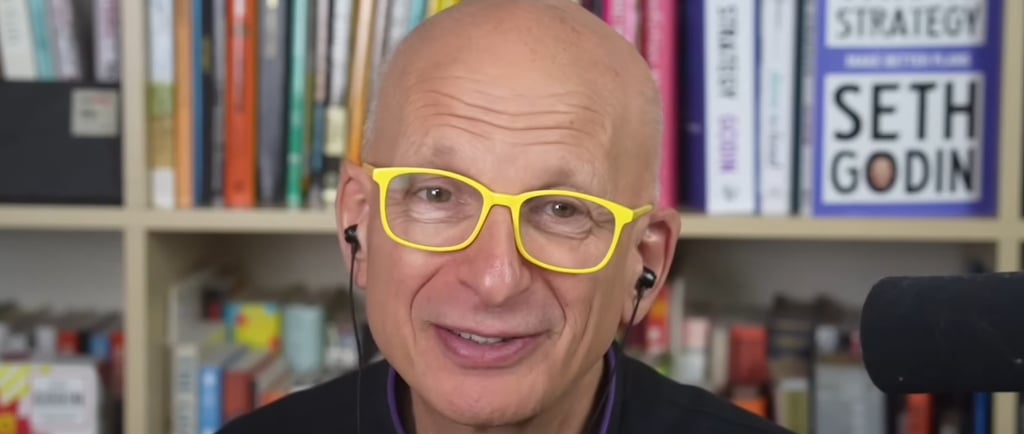

About this video
Seth Godin is one of the world’s most influential marketing thinkers, a bestselling author, and an entrepreneur whose ideas on permission marketing, leadership, and making remarkable work have shaped modern business.
Most business decision makers are not failing because they lack effort — they are failing because they are executing tactics without a clear strategic direction. The core insight here is that strategy is not “planning harder”; it is deciding who you are serving, what change you want to create, and what work you are willing to refuse.
The uncomfortable trade-off is this: saying yes to every client, platform, or tactic may feel safe in the short term, but it often traps businesses into becoming average providers for average customers. Better positioning usually requires selective sacrifice before it produces visible results.
Full Video at the end of page
Core Insight (Plain English)
Most SMEs spend too much time copying visible tactics — posting more content, chasing trends, accepting every customer — without first deciding what business they are actually trying to build.
Strategy is not about moving faster. It is about choosing the right direction before you accelerate.
The businesses that grow sustainably usually become known for solving a specific problem for a specific type of customer. The businesses that struggle often become reactive generalists, constantly busy but rarely differentiated.
7 Practical Lessons
Stop copying tactics before understanding the market position behind them.
A competitor’s social media strategy, pricing model, or branding only works because of the ecosystem around it. Copying the surface without understanding the underlying positioning usually creates noise, not advantage.Define who you are not serving.
Businesses become clearer and more valuable when they intentionally reject poor-fit customers. In Southeast Asia’s crowded SME landscape, clarity often beats scale early on.Better clients are usually attracted through positioning, not harder work.
Doing excellent work for low-value clients rarely upgrades your market position automatically. You need visible signals that communicate specialisation and intent.Spend time working on the business, not only in it.
Constant operational firefighting feels productive but often prevents structural improvements. Even small strategic decisions — automation, pricing redesign, customer filtering — can compound significantly.Opportunity cost matters more as businesses grow.
Every low-quality client, unnecessary meeting, or reactive task consumes time that could have built stronger systems, skills, or partnerships.Build proof around the work you actually want.
If your portfolio only reflects compromise work, the market will continue sending similar opportunities. Create case studies, side projects, or pilot work that reflects your intended positioning.Customer decisions are often influenced by hidden stakeholders.
The India hospital example is critical: the apparent customer was not the real decision-maker.
In Southeast Asia especially, family influence, procurement hierarchy, community trust, and peer validation often shape buying behaviour more than direct advertising.
Summary & Reflections
This framework is powerful because it forces operators to confront uncomfortable questions about identity, positioning, and trade-offs. However, selective positioning is easier to advocate than to execute — especially for SMEs facing cash flow pressure.
Not every business can immediately reject mediocre clients or narrow its market focus. Early-stage operators often need operational stability before strategic purity becomes realistic. There is also a risk of over-romanticising specialisation when some markets reward flexibility and responsiveness instead.
Regional Consideration (Southeast Asia)
Many SMEs operate in fragmented, price-sensitive markets where saying “no” to customers can feel financially dangerous.
Relationship networks, referrals, and family influence often shape purchasing decisions more than brand messaging alone.
Operators may need a hybrid approach: maintaining broad cash-flow operations while gradually building a more differentiated strategic position.
Who should watch the full video
SME founders struggling with positioning or differentiation
Freelancers and agencies trapped in low-value client cycles
Creative entrepreneurs overwhelmed by constant tactical execution
Marketing and branding operators trying to clarify strategic direction
Solopreneurs balancing survival work with long-term business building
Decision Rating
Decision Usefulness: ★★★★★
This discussion directly addresses one of the most common SME problems: confusing activity with progress. The ideas are highly actionable for operators making decisions about customers, positioning, and resource allocation.
Strategic Value: ★★★★★
The conversation strongly reframes strategy as customer selection, ecosystem awareness, and long-term positioning rather than tactical execution. Particularly valuable for SMEs facing commoditisation.
Practical Applicability: ★★★★☆
The concepts are practical, but implementation can be emotionally and financially difficult for smaller operators under immediate cash flow pressure. The advice works best when adapted gradually rather than applied rigidly.
Until next time,
The SME Signal editorial Team

Contact
Questions? Reach out anytime.
hello@smesignal.com
© 2026. All rights reserved.