
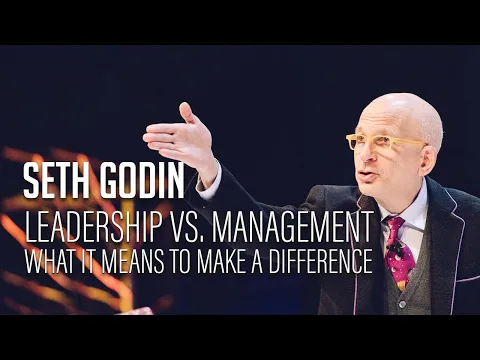
Leadership vs. Management - What it means to make a difference
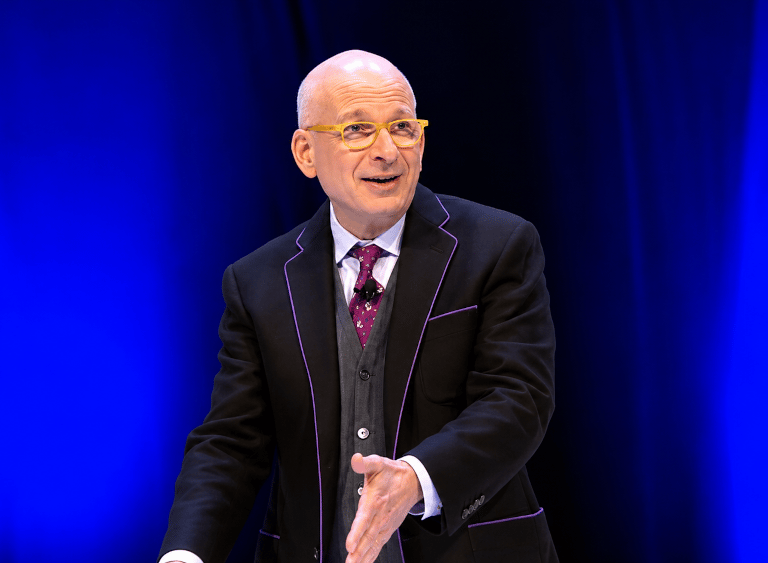
This keynote, delivered by marketing and leadership author Seth Godin, challenges many traditional assumptions about management, Lean thinking, innovation and organisational leadership. Rather than focusing on efficiency alone, the discussion explores how responsibility, experimentation and empathy increasingly shape competitive organisations. Speaker: Seth Godin | Podcast: Nordic Business Forum | Views as of post date: > 2,100,000
KNOWLEDGE

About this video
Seth Godin is the marketing thinker, bestselling author, and entrepreneur best known for popularising permission marketing and reshaping how businesses think about trust, ideas, and audience building.
The emerging signal is that competitive advantage is shifting away from organisations that simply execute efficiently toward organisations that consistently produce leaders capable of navigating uncertainty. As technology automates more standardised work, the differentiator increasingly becomes judgement, responsibility, empathy, experimentation, and the ability to mobilise people around change.
For SME operators, the implication is clear: improving operational efficiency remains necessary, but it is no longer sufficient. Businesses that continue optimising yesterday's operating model without developing leadership capability may find themselves increasingly vulnerable when markets, technologies, or customer expectations shift.
Full Video at the end of page
Core Insight (Plain English)
For decades, many businesses were built around the assumption that success comes from creating repeatable processes, improving efficiency, and reducing variation. That model worked exceptionally well in stable environments.
The speaker argues that this assumption is becoming less reliable. As markets become more dynamic, technology evolves faster, and AI increasingly automates standardised work, organisations must become better at dealing with uncertainty rather than simply optimising consistency.
This changes an important business assumption:
Future competitiveness may depend less on having better processes and more on having people who can continuously redesign those processes.
The distinction between management and leadership becomes increasingly important.
Management focuses on executing known work well.
Leadership focuses on discovering what should happen next.
For many SMEs, this is less about replacing management than about recognising when the business needs one versus the other.
What this means for operators
1. Operational excellence alone is becoming less defensible.
Lean operations, quality systems, automation and standardisation remain valuable, but competitors can increasingly replicate these capabilities. Operators should invest equally in developing decision-making and adaptability.
2. Build cultures that reward responsible experimentation.
Innovation is presented not as occasional inspiration but as repeatedly testing ideas, learning from mistakes, and taking ownership of outcomes.
Operators should ask whether employees are encouraged to improve systems or merely comply with them.
3. Leadership should become more distributed.
The talk argues that leadership is less about formal authority and more about voluntarily taking responsibility.
SMEs often have flatter structures, giving them an advantage if employees are trusted to solve problems rather than simply escalate them.
4. Customer understanding becomes a strategic capability.
Empathy is described not as kindness but as accurately understanding how customers see the world.
Operators should continually test whether products, services and communications reflect customer reality rather than internal assumptions.
5. Better decisions matter more than perfect outcomes.
The discussion distinguishes between making a good decision and simply experiencing a fortunate outcome.
As uncertainty increases, operators should evaluate decision quality, assumptions and learning—not only whether results happened to be positive.
6. Soft skills increasingly become economic skills.
Communication, trust, initiative, adaptability and responsibility are framed as capabilities that distinguish people from increasingly capable automation.
Hiring and development priorities may gradually shift in this direction.
Practical watchpoints
Operators should monitor:
Whether employees proactively solve problems or wait for instructions.
Whether management meetings create decisions or simply distribute responsibility.
Whether customer feedback reflects genuine empathy or internal assumptions.
Whether AI and automation are replacing routine work faster than leadership capability is developing.
Whether hiring criteria continue to overweight technical competence while undervaluing initiative, communication and judgement.
Summary & Reflections
The presentation makes a compelling case that leadership capabilities are becoming more valuable in an increasingly uncertain economy. However, the argument should not be interpreted as suggesting management no longer matters.
Many industries—including manufacturing, logistics, healthcare and regulated sectors—still depend heavily on disciplined execution, quality control and repeatable processes. In practice, sustainable organisations typically require both strong management and effective leadership.
The signal is therefore not that management is obsolete.
Rather, the balance between operational efficiency and adaptive leadership may be shifting.
Regional Consideration (Southeast Asia)
For Southeast Asian SMEs, this signal may be particularly relevant because many businesses compete through operational efficiency and cost effectiveness. As AI tools become more accessible, differentiation may increasingly depend on leadership capability, customer understanding, organisational learning and the speed at which firms adapt to changing markets rather than cost advantages alone.
Who should watch the full video
This presentation would be particularly valuable for:
SME owners
Startup founders
CEOs and Managing Directors
Operations leaders
HR and People leaders
Innovation managers
Product managers
Business transformation teams
Leadership development professionals
Decision Rating
Decision Usefulness ★★★★★
This talk provides highly actionable guidance for SME operators because it focuses on leadership behaviours, decision-making, experimentation and organisational culture rather than abstract theory. These themes directly influence how businesses respond to uncertainty.
Leadership Relevance ★★★★★
Leadership is the central theme throughout the presentation. The discussion offers practical distinctions between management and leadership that are especially relevant for founders and business owners responsible for guiding organisational change.
Operational Relevance ★★★★☆
Although much of the talk emphasises leadership, it also challenges operators to rethink meetings, decision-making, Lean practices, customer empathy and quality management. The ideas are broadly applicable, though some examples are philosophical rather than immediately operational.
Until next time,
The SME Signal editorial Team
Contact
Questions? Reach out anytime.
hello@smesignal.com
© 2026. All rights reserved.