
The Business Strategies Behind Trader Joe’s, Primark, Chipotle and More
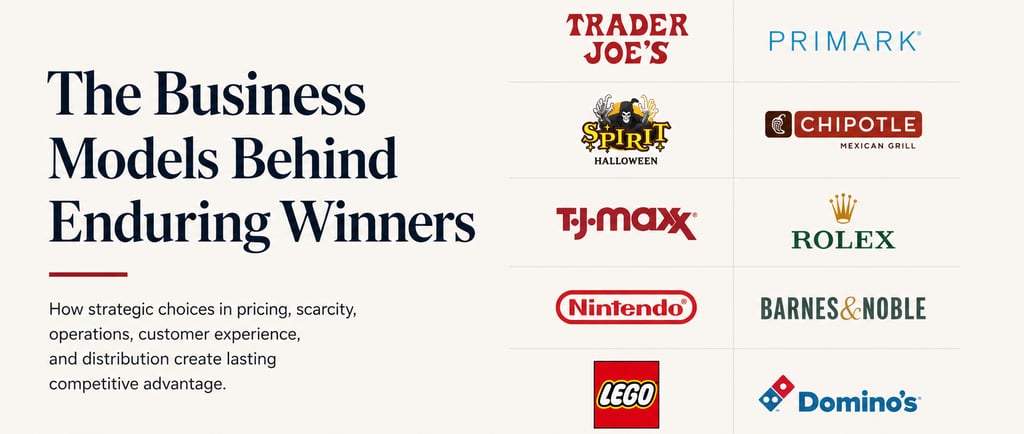
This discussion looks at the business models behind companies such as Trader Joe’s, Primark, Spirit Halloween, Chipotle, TJ Maxx, Rolex, Nintendo, Barnes & Noble, LEGO, and Domino’s, highlighting the strategic choices that have enabled them to stay competitive and profitable. Podcast: The Wall Street Journal | Views as of post date: > 2,800,000
STRATEGY
About this video
The Wall Street Journal is one of the world’s most influential business newspapers, renowned for authoritative reporting, sharp financial analysis, and agenda-setting coverage of markets, politics, and global affairs.
Many of the most resilient businesses do not win by doing more. They win by deliberately doing less, focusing on a few capabilities they execute exceptionally well, and designing the entire business model around those strengths.
The key decision insight is that competitive advantage often comes from what a company chooses not to do. Trader Joe’s avoids endless product choice, Primark avoids full e-commerce, Chipotle simplifies its menu, and Domino’s built around delivery long before competitors. Focus creates operational advantages that competitors struggle to copy
Full Video at the end of page
Core Insight (Plain English)
Most businesses chase growth by adding products, channels, features, and complexity.
The stronger approach is often the opposite: identify the few things customers truly value, build your operations around them, and remove everything that weakens focus.
Growth is easier when the business model is simple enough to execute consistently and distinctive enough that customers immediately understand why you exist.
7 Practical Lessons
Remove complexity before adding growth initiatives. Trader Joe’s carries far fewer products than traditional supermarkets, reducing inventory complexity while improving customer experience.
Not every industry benefits equally from digitisation. Primark avoided full e-commerce because delivery and returns would damage already-thin margins. Before investing in digital channels, confirm they improve profitability, not just revenue.
Build systems around operational speed. TJ Maxx succeeds partly because buyers can make purchasing decisions quickly and move inventory to stores fast. Slow approval processes create hidden costs.
Offer customisation without operational chaos. Chipotle keeps a small menu but allows extensive combinations. Customers feel they have choice without the business carrying excessive complexity.
Own the customer relationship when possible. Domino’s continues investing in its own ordering ecosystem rather than relying entirely on third-party delivery platforms that reduce margins and customer ownership.
Turn products into ecosystems. Nintendo and LEGO expanded beyond physical products into games, movies, content, and experiences that reinforce their core business rather than distract from it.
Give local operators room to respond to local demand. Barnes & Noble improved performance by allowing stores to tailor selections to local communities rather than forcing uniformity across every location. This is especially relevant in fragmented Southeast Asian markets where customer preferences can vary significantly between cities and regions.
Summary & Reflections
The common theme across these companies is focus, but focus is easier to admire than to execute.
Many businesses copy the visible tactic rather than the underlying economics. Refusing e-commerce worked for Primark because of its cost structure and store traffic. A different retailer might damage its business by making the same choice.
Similarly, limiting product selection only works when customers trust the brand’s ability to curate effectively. Poor selection with fewer choices simply becomes a weaker offering.
Regional Consideration (Southeast Asia)
Market fragmentation often requires balancing standardization with local adaptation.
Digital channels may be more important in Southeast Asia than in some Western markets because of mobile-first consumer behavior.
The lesson is not "avoid digital" but "ensure digital strengthens the economics of the business."
Who should watch the full video
SME founders
Retail operators
Consumer brand owners
F&B operators
E-commerce leaders
Franchise operators
Business strategy and growth teams
Especially useful for operators evaluating expansion, product portfolio growth, channel strategy, or digital transformation investments.
Decision Rating
Decision Usefulness: ★★★★★
The transcript provides multiple real-world examples of how business model design, operational focus, and channel choices create competitive advantage. The lessons are highly transferable across industries.
Strategic Value: ★★★★★
The strongest insight is understanding that competitive advantage often comes from deliberate constraints and trade-offs. This is directly relevant to growth, positioning, and resource allocation decisions.
Practical Applicability: ★★★★☆
Many ideas can be applied immediately—simplifying offerings, improving operational speed, or reassessing channel strategy. However, individual tactics require adaptation to industry economics and local market realities.
Until next time,
The SME Signal editorial Team

Contact
Questions? Reach out anytime.
hello@smesignal.com
© 2026. All rights reserved.